
Architecture
A high-level look at how Leaf is built. (Contributor docs are a work in progress - expect this to deepen over time.)
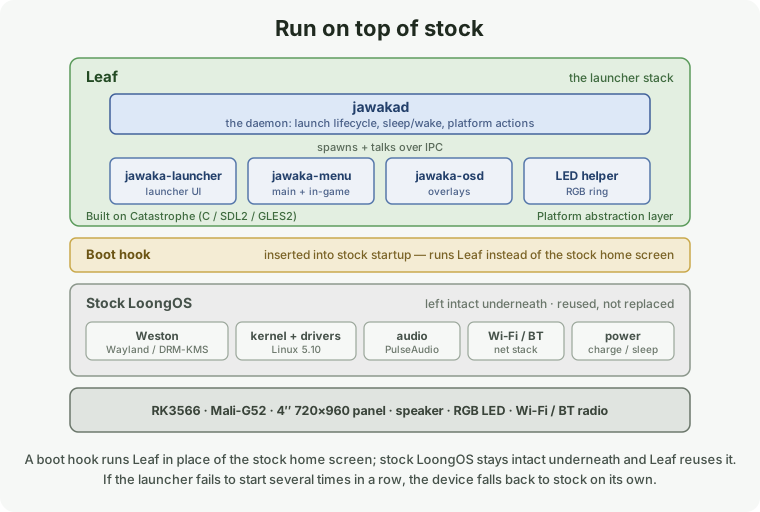
Run on top of stock
Section titled “Run on top of stock”Leaf’s defining choice is that it does not replace the stock OS. A boot hook inserted into the device’s normal startup takes over before the stock home screen appears, and runs the Leaf launcher instead - while leaving stock LoongOS intact underneath.
Consequences of this model:
- Crash-safety fallback. A guard counts launcher startups in a short window; if Leaf fails to start cleanly several times in a row, the device falls back to the stock interface instead of bricking or boot-looping.
- Reuse, not reinvention. Leaf uses the stock display server, audio, Wi-Fi, and power systems rather than shipping its own drivers.
- Recoverable by design. Because stock is always present, a recovery card can restore the device fully.
The launcher stack
Section titled “The launcher stack”The launcher is several cooperating processes:
jawakad- the daemon. Owns the launch lifecycle, sleep/wake, platform actions, performance profiles, and coordination with the in-game menu.jawaka-launcher- the on-screen launcher UI.jawaka-menu- the main menu and in-game menu.jawaka-osd- on-screen overlays (volume/brightness).- A small LED helper drives the RGB ring.
The daemon is the normal entry point; the UI binaries are spawned by it. The daemon and UI communicate over a local IPC channel (used for things like performance changes and in-game menu actions).
Catastrophe (the UI toolkit)
Section titled “Catastrophe (the UI toolkit)”The launcher and Leaf-native apps are built on Catastrophe, a small C UI toolkit. The launcher exports its appearance (colors, list/pill style, fonts, hint visibility) to apps through environment variables, so any app built on Catastrophe inherits the launcher’s look automatically.
Platform abstraction
Section titled “Platform abstraction”Device-specific behavior (display, audio, Wi-Fi, Bluetooth, LED, performance, and storage) sits behind a platform layer, so the bulk of the launcher stays device-agnostic and new hardware can be added behind the same interface.
Graphics
Section titled “Graphics”The device composites through a Wayland compositor, and Leaf renders with GLES2, the supported, working graphics path on this hardware.